Last updated: May 2026 | 2,600 words | Reading time: 12 min

If your lawn has a slope, you already know the frustration. Standard robot mowers slip, stall, or simply refuse to go beyond 20% gradient. You spend your weekends pushing a heavy mower up hills while your neighbors with flat lawns relax with a beer.
The good news: in 2026, AWD robot mowers have genuinely solved this problem. The bad news: not every mower marketed for slopes actually handles them well in the real world.
This guide cuts through the marketing claims. We explain exactly what slope rating means, which models genuinely perform on steep terrain, and when a cheaper RWD mower is actually enough for your garden.
The Short Answer: What Slope Do You Have?
Before reading further, grab your phone and download a free clinometer app. Measure your steepest section. This one number determines everything.
| Your Steepest Slope | What You Need |
|---|---|
| Under 20% (11°) | Any standard robot mower |
| 20–35% (11–19°) | RWD with traction management |
| 35–50% (19–27°) | AWD essential |
| 50–80% (27–39°) | AWD high-torque, e.g. Mammotion LUBA 3 |
| Over 80% (39°+) | Tracked system required |
Most homeowners underestimate their slope by 10–15 degrees. Always measure before buying.
AWD vs RWD: What Actually Matters on a Slope
Rear-Wheel Drive (RWD) – The Standard
Most robot mowers use RWD. On flat or gently sloping lawns (under 20%), this works perfectly well. The rear wheels push the mower forward while the front wheels steer.
The problem starts on steeper terrain. When a RWD mower hits a slope above 20%, the rear wheels lose traction, especially on wet grass. The mower either slips sideways, stalls, or triggers a safety shutoff.
Best for: Flat to gently rolling lawns under 20% gradient.
All-Wheel Drive (AWD) – Built for Hills
AWD mowers power all four wheels independently. Each wheel adjusts torque in real time based on traction conditions – similar to how a 4×4 car handles off-road terrain. On wet grass, uneven ground, or steep inclines, AWD maintains grip where RWD fails completely.
The difference on a 45% slope between AWD and RWD is not marginal – it is the difference between a mower that works and one that doesn’t.
Best for: Any lawn with slopes above 35%, wet conditions, or uneven terrain.
Top 6 Robot Mowers for Slopes 2026
🥇 1. Mammotion LUBA 3 AWD 5000 — Best Overall for Slopes
Price: ~$2,199 | Slope: 80% (38.6°) | Coverage: 5,000 m² | Navigation: NetRTK (iNavi) + LiDAR + AI Vision
The LUBA 3 AWD 5000 is the benchmark for slope performance in 2026. Its AWD system delivers independent torque to each wheel, maintaining grip on gradients that stop every other residential mower in its tracks.
What separates it from previous AWD models is the combination of navigation systems. Mammotion’s iNavi NetRTK pulls positioning correction data from mobile network towers via 4G – no physical antenna required. This matters on sloped lawns because trees, hedges and terrain variations that disrupt traditional RTK signals are exactly what sloped properties tend to have more of. The iNavi service is free for the lifetime of the device.
The Tri-Fusion system adds LiDAR scanning and AI Vision on top of NetRTK, meaning the mower maintains accurate positioning even under dense tree canopy. Night mowing is supported. Up to 20 separate zones can be configured with individual schedules and cutting heights.
Real-world performance: Handles wet grass on 80% slopes without slipping. Independent front suspension absorbs uneven terrain that would destabilize flat-bottomed designs.
Who it is for: Large lawns with serious slopes – anyone with terrain above 45% who wants a fully automated solution.
✅ Pros: Best-in-class 80% slope rating, NetRTK no antenna needed, 20 zones, night mowing, replaceable battery, iNavi free for life ❌ Cons: Higher price, app complexity for first-time users, larger physical footprint
🏔️ 2. Mammotion Luba Mini 2 AWD 1000 — Best for Small Steep Lawns
Price: ~$1,699 | Slope: 80% (38.6°) | Coverage: 1,000 m² | Navigation: NetRTK (iNavi) + AI Vision
The Luba Mini 2 AWD solves a problem that no other mower addresses at this price: a small lawn with a genuinely steep slope. Most AWD mowers are built for large properties. This one brings identical 80% slope performance to gardens under 1,000 m².
Like the LUBA 3, it uses iNavi NetRTK – no antenna pole, no line-of-sight satellite requirements. Positioning correction arrives via 4G from mobile network towers, free for life.
The secondary edge-cutting disc is a standout feature. It cuts to within 2.5 cm of lawn boundaries – dramatically reducing the manual edge trimming that every other mower leaves behind. The 6.1 Ah battery delivers 160 minutes of runtime per charge, and the battery is user-replaceable – unusual at this price point.
Who it is for: Homeowners with small to medium gardens and slopes that have defeated every other mower they’ve tried.
✅ Pros: 80% slope on a compact design, NetRTK free for life, excellent edge cutting, long battery life, replaceable battery ❌ Cons: Limited to 1,000 m², newer brand vs Husqvarna, premium price for coverage size
🔵 3. Segway Navimow i206 AWD — Best Mid-Range AWD
Price: ~$1,799 | Slope: 45% | Coverage: 3,000 m² | Navigation: RTK + Vision AI + ESC
The Navimow i206 AWD brings automotive-grade Electronic Stability Control (ESC) to robot mowing – a genuinely useful feature on slopes. The ESC system detects when a wheel is losing traction and redistributes power automatically, similar to stability control in a car.
It handles slopes up to 45% reliably and covers up to 3,000 m² – making it the strongest mid-range AWD option for homeowners who need slope capability but don’t want to go to Mammotion LUBA 3 pricing.
Setup is wire-free with automatic lawn mapping. The app is straightforward for first-time robot mower users.
Who it is for: Homeowners with moderate to steep slopes (up to 45%) on medium-sized lawns who want AWD without paying LUBA 3 prices.
✅ Pros: Automotive ESC for stability, solid 45% slope rating, good coverage area, easy setup ❌ Cons: Traditional RTK requires better sky visibility than NetRTK, less capable than Mammotion on steepest slopes
⚠️ 4. Husqvarna Automower 435X AWD — AWD But Know the Limits
Price: ~$3,499 | Slope: 35° (70%) | Coverage: 3,500 m² | Navigation: EPOS RTK (physical station)
The 435X AWD is Husqvarna’s professional AWD option and it performs well on slopes up to 35 degrees. The articulated steering design combined with AWD gives it excellent stability on complex terrain.
However – two important caveats. First, it still uses a physical EPOS reference station, unlike Mammotion’s antenna-free NetRTK approach. On heavily wooded or terrain-complex properties, this can create navigation dead zones. Second, at $3,499 it costs significantly more than the Mammotion LUBA 3 AWD 5000 which handles steeper slopes for $1,300 less.
Who it is for: Existing Husqvarna users who want AWD and value the brand’s 25-year reliability track record above all else.
✅ Pros: Proven Husqvarna reliability, articulated steering, strong dealer network, 4-year warranty ❌ Cons: Expensive, physical EPOS station required, lower slope rating than Mammotion at higher price
✅ 5. Segway Navimow i110N — Best RWD for Gentle Slopes
Price: ~$1,299 | Slope: 35% | Coverage: 2,700 m² | Navigation: RTK + Vision AI
If your steepest section is genuinely under 35% – and you have measured it accurately – the Navimow i110N is the most cost-effective wire-free mower available. It handles gentle to moderate slopes well with RWD, saves you $400–900 over AWD alternatives, and is significantly easier to set up.
The honest caveat: 35% is less than you think. If you are unsure whether your slope reaches 35%, assume it does and buy AWD. A mower that slips on your lawn is worse than paying more upfront.
Who it is for: Homeowners who have accurately measured slopes under 35% and want the best value wire-free mower.
✅ Pros: Great value, wire-free, reliable on gentle slopes, easy setup ❌ Cons: RWD limits – struggles above 30% on wet grass, no AWD upgrade path
💰 6. Worx Landroid WR155 — Best Budget RWD
Price: ~$699 | Slope: 20% | Navigation: Boundary wire
The Landroid uses traditional boundary wire which actually helps on slopes – the physical boundary means it never drifts toward a slope edge. For genuinely flat to very gently sloping lawns under 20%, it remains the most affordable reliable option.
Do not buy this if your lawn exceeds 20% slope. It will fail.
Who it is for: Budget buyers with flat or near-flat lawns who want basic reliable automation.
✅ Pros: Lowest price, reliable once installed, proven long-term performance ❌ Cons: 20% slope limit is a hard ceiling, requires wire installation, no wire-free option
The Slope Decision Guide
Use this to pick your mower in 60 seconds:
Step 1 – Measure your steepest slope with a free clinometer app.
Step 2 – Check your lawn size.
Step 3 – Match to this table:
| Slope | Lawn Size | Recommended Model |
|---|---|---|
| Under 20% | Any | Worx Landroid (budget) or Navimow i110N |
| 20–35% | Under 3,000 m² | Navimow i110N |
| 35–50% | Under 3,000 m² | Segway Navimow i206 AWD |
| 50–80% | Under 1,000 m² | Mammotion Luba Mini 2 AWD |
| 50–80% | 1,000–5,000 m² | Mammotion LUBA 3 AWD 5000 |
| Over 80% | Any | Tracked system required |
Common Slope Mistakes That Cost Money
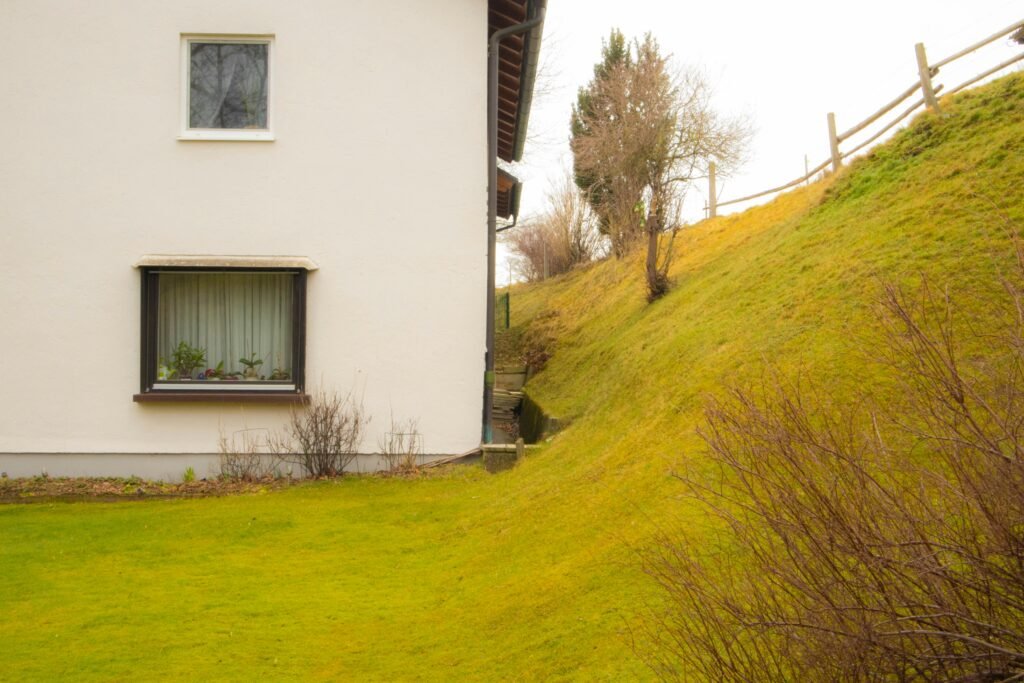
Mistake 1 – Trusting your eyes instead of measuring. A slope that looks gentle is often 25–30%. Measure it.
Mistake 2 – Buying RWD for a 30% slope. RWD mowers rated for 35% are tested on dry, ideal surfaces. Wet grass drops real-world performance by 30–40%. A 35% rated RWD mower will struggle on a wet 25% slope.
Mistake 3 – Ignoring navigation on wooded slopes. Trees next to slopes are double trouble for traditional RTK. NetRTK systems like Mammotion’s iNavi solve this – GPS satellites and physical antennas both lose signal under canopy, but mobile network towers don’t.
Mistake 4 – Assuming AWD means any slope. AWD handles steep slopes significantly better than RWD. It does not make a mower invincible. Above 80% gradient (38.6°), wheeled mowers of any kind reach their physical limits.
What About Tracked Robot Mowers?
For extreme slopes above 80% grade, wheeled AWD systems reach their limits. Tracked mowers like the Lymow One Plus use continuous tank-style treads that distribute weight across a larger surface area, maintaining traction where wheels slip on very steep or soft ground.
These are niche products for extreme terrain – most residential lawns do not require them. If your lawn genuinely exceeds 38.6° on any section, measure carefully and consider whether a tracked system is needed for that specific area.
Final Verdict
For most homeowners with sloped lawns in 2026, the Mammotion LUBA 3 AWD 5000 is the clear recommendation. It handles the steepest residential slopes, eliminates the antenna frustration of traditional RTK through NetRTK iNavi, and costs less than the Husqvarna AWD alternative.
For smaller gardens with serious slopes, the Mammotion Luba Mini 2 AWD 1000 brings identical slope performance in a compact format.
If your slope is genuinely under 35% and you have measured it accurately, the Segway Navimow i110N saves you significant money without meaningful sacrifice.
The most expensive mistake in this category is buying a RWD mower for a slope that needs AWD. Measure first. Buy once.
Prices shown are approximate at time of writing. Always check current pricing before purchasing. RobotMowerGuide.com uses affiliate links — if you buy through our links we may earn a commission at no extra cost to you.